
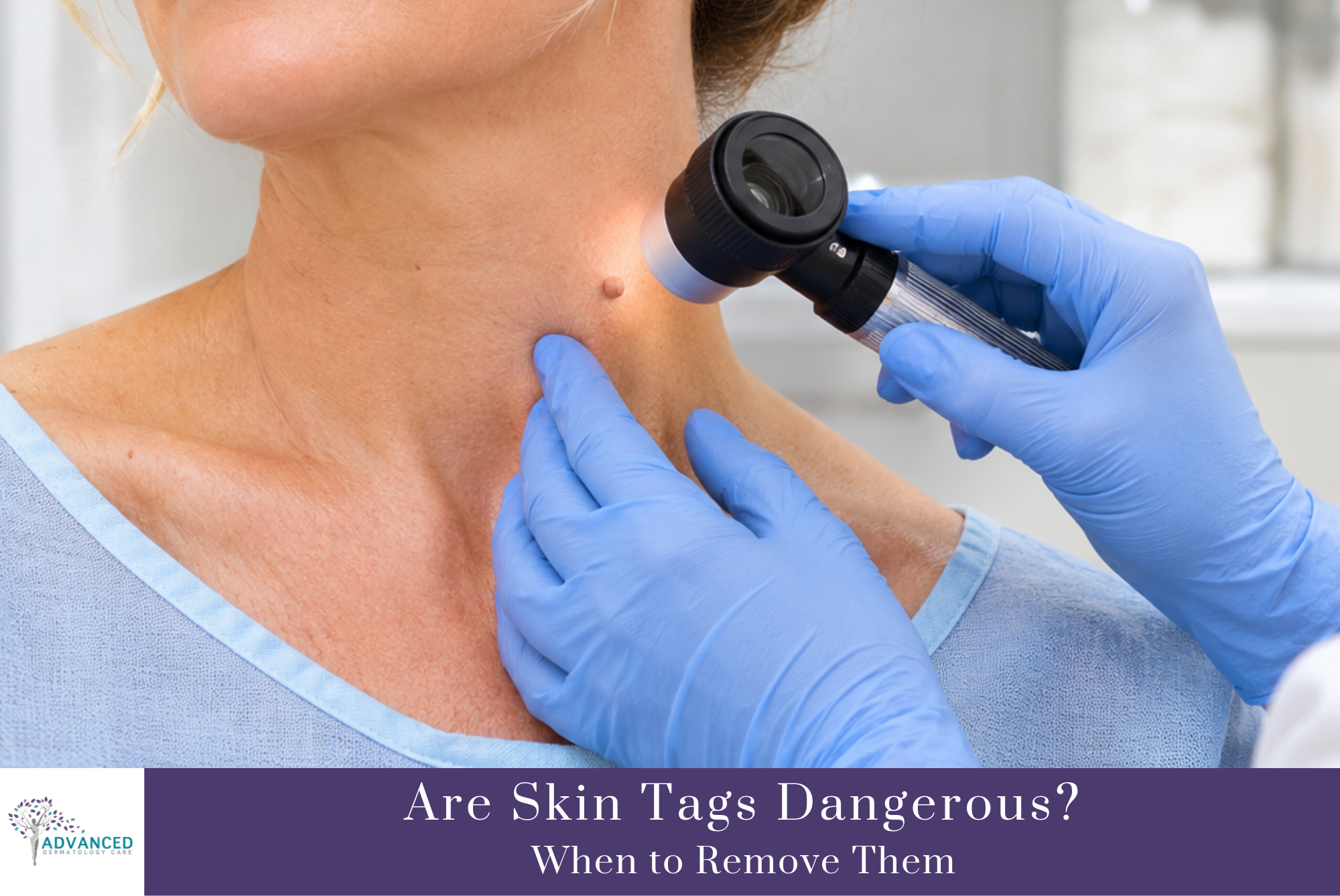
Skin tags are among the most common benign skin growths. They frequently appear on the neck, underarms, eyelids, groin, and other areas where skin rubs against skin or clothing.
Although skin tags are generally harmless, they can become irritated, bleed after friction, or cause cosmetic concerns. Some growths that resemble skin tags can also represent other dermatologic conditions, making accurate identification important.
At Advanced Dermatology Care, serving Los Alamitos and Agoura Hills, California, professional skin examinations help patients determine whether a growth is a harmless skin tag or requires additional evaluation.
What Are Skin Tags?
Skin tags, medically known as acrochordons, are soft, benign growths composed of skin tissue and connective tissue.
They are usually flesh-colored or slightly darker than the surrounding skin.
Some have a narrow stalk, while others attach to the skin through a broader base.
Skin tags range from tiny bumps to larger, soft growths.
They are not contagious and do not ordinarily transform into skin cancer.
What Causes Skin Tags?
The exact mechanisms responsible for skin tag development are not completely understood.
However, several factors are associated with their appearance.
Skin Friction
Skin tags frequently develop in areas exposed to repeated rubbing.
Common locations include the neck, underarms, beneath the breasts, and groin.
Genetics
A family history of skin tags can increase the likelihood of developing them.
Aging
Skin tags become more common during adulthood and with increasing age.
Insulin Resistance and Metabolic Factors
Multiple skin tags have been associated with obesity, insulin resistance, and metabolic syndrome in observational research.
However, having skin tags does not automatically indicate diabetes or another metabolic disorder.
Patients with additional risk factors can discuss appropriate metabolic screening with their healthcare professional.
Pregnancy and Hormonal Changes
Skin tags can become more noticeable during pregnancy, potentially because of hormonal changes and increased friction.
Are Skin Tags Ever Dangerous?
A confirmed skin tag is benign and generally does not require treatment.
However, a growth that looks like a skin tag is not necessarily one.
Certain moles, warts, seborrheic keratoses, and other lesions can have similar appearances.
Occasionally, a skin cancer can resemble a benign growth.
A lesion that changes rapidly, bleeds without injury, becomes unusually firm, develops irregular pigmentation, or forms an ulcer should be evaluated.
When Should a Skin Tag Be Removed?
Removal is commonly considered when a skin tag repeatedly catches on clothing or jewelry, becomes irritated during shaving, causes discomfort, interferes with vision because of its eyelid location, or creates cosmetic concerns.
Removal is usually elective when the growth is harmless and asymptomatic.
How Dermatologists Remove Skin Tags
Several office-based techniques can remove confirmed skin tags.
Snip Excision
A dermatologist can remove a skin tag using sterile instruments.
Depending on its size and location, local anesthesia may be used.
Cryotherapy
Cryotherapy involves applying controlled cold temperatures, commonly using liquid nitrogen, to destroy selected skin growths.
The treated tissue subsequently separates as the area heals.
Electrosurgery
Electrosurgery uses controlled electrical energy to remove or destroy tissue.
The appropriate method depends on the lesion’s characteristics, location, and patient-specific factors.
Is It Safe to Remove Skin Tags at Home?
Home removal is not recommended.
Cutting skin tags with household instruments can cause bleeding, infection, and scarring.
Chemical removal products can damage surrounding skin, particularly on sensitive areas such as the eyelids.
Attempting removal without confirming the diagnosis can also delay identification of a more serious lesion.
The American Academy of Dermatology provides additional information about skin tags and professional removal.
Can Skin Tags Grow Back?
A completely removed skin tag generally does not regrow from the same tissue.
However, new skin tags can develop elsewhere, particularly in individuals who are predisposed to them.
Skin Tag Removal in Los Alamitos and Agoura Hills
Patients seeking evaluation of skin tags and other growths benefit from professional diagnosis before treatment.
Advanced Dermatology Care provides dermatologic evaluations for patients throughout Los Alamitos, Seal Beach, Cypress, Agoura Hills, Calabasas, Westlake Village, and nearby communities.
Frequently Asked Questions About Skin Tags
Are skin tags cancerous?
No. True skin tags are benign. However, suspicious growths that resemble skin tags should be evaluated to confirm the diagnosis.
Can skin tags become melanoma?
A confirmed skin tag does not ordinarily develop into melanoma.
Why am I suddenly getting more skin tags?
Increasing age, friction, weight changes, pregnancy, and metabolic factors can contribute. A sudden increase deserves discussion with a healthcare professional, especially when accompanied by other symptoms.
Do skin tags need to be removed?
No. Removal is generally optional unless a skin tag causes irritation, bleeding, functional problems, or cosmetic concerns.
Does skin tag removal hurt?
Most office procedures cause limited discomfort. Local anesthesia can be used when appropriate.
Can skin tags spread to other people?
No. Skin tags are not contagious.
Will skin tag removal leave a scar?
Minor temporary skin changes are possible. Scarring risk depends on the removal technique, location, and individual healing response.
Should I remove a skin tag on my eyelid?
Eyelid growths should be evaluated professionally because of the delicate surrounding anatomy and the need to confirm the diagnosis.
Contact Information
Advanced Dermatology Care
Los Alamitos Office
3851 Katella Avenue, Suite 105
Los Alamitos, CA 90720
Phone: (562) 799-3330
Agoura Hills Office
30300 Agoura Road, Suite 200
Agoura Hills, CA 91301
Phone: (818) 706-3744
Website: mddermcare.com
Book Online: Schedule Your Appointment
Schedule an evaluation to discuss a bothersome skin tag or an unexplained skin growth.