
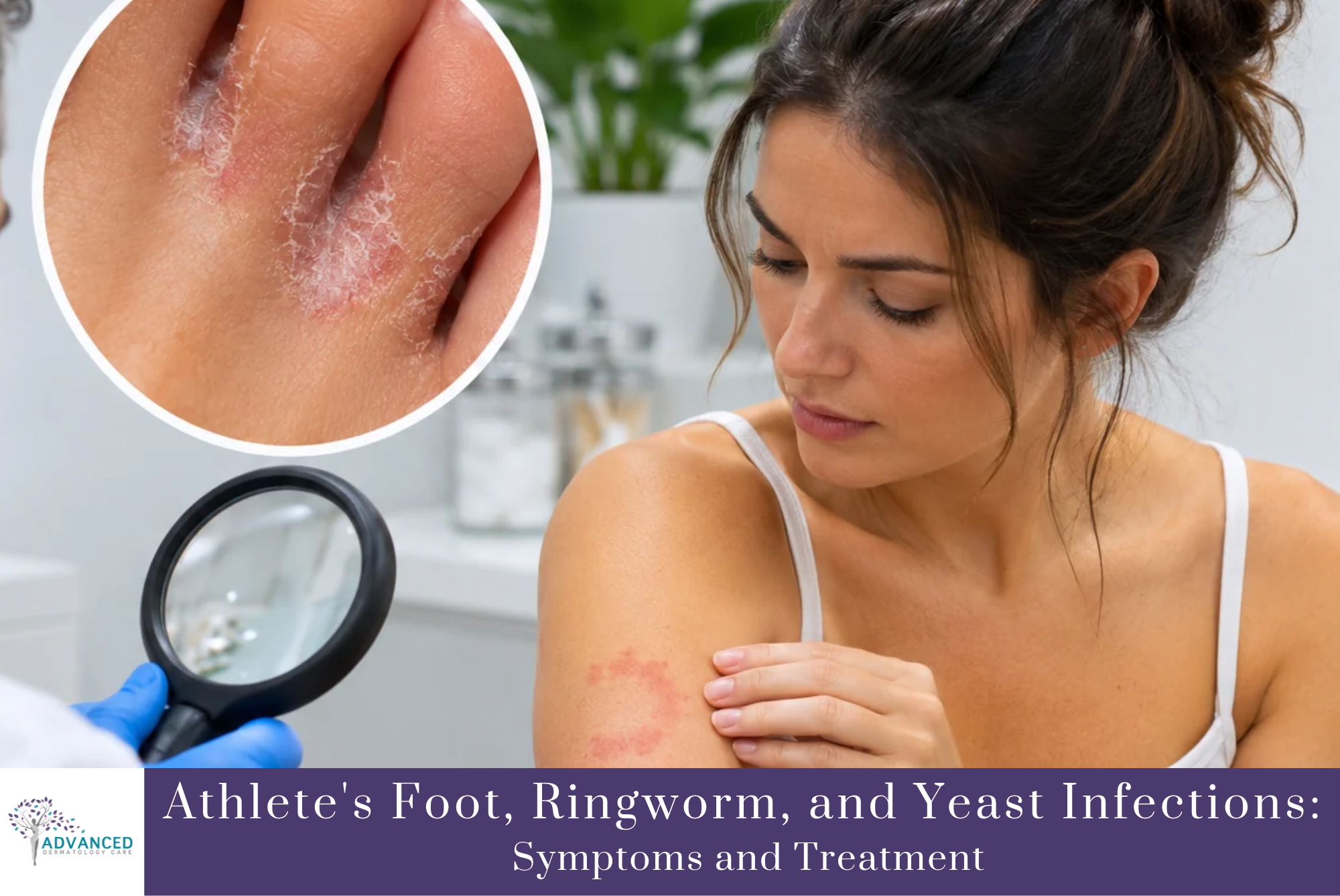
Fungal skin infections are common dermatologic conditions that affect people of all ages. They frequently develop in warm, moist environments and can involve the feet, body, groin, scalp, nails, and skin folds.
Although athlete’s foot, ringworm, and yeast infections are sometimes grouped together, they are caused by different types of fungi and can require different treatments.
At Advanced Dermatology Care, serving Los Alamitos and Agoura Hills, California, professional dermatologic evaluations help distinguish fungal infections from other inflammatory skin conditions and guide appropriate antifungal therapy.
Understanding Fungal Skin Infections
Fungi naturally exist throughout the environment, and certain fungal organisms live on human skin without causing disease.
Infection develops when susceptible organisms multiply in favorable conditions or invade superficial skin structures.
Dermatophytes are fungi that use keratin and commonly infect the skin, hair, and nails.
Yeasts such as Candida can cause infections in moist skin folds and other susceptible areas.
Correct identification is important because not every antifungal medication treats every organism equally well.
Athlete’s Foot: Tinea Pedis
Athlete’s foot is a dermatophyte infection involving the feet.
It commonly affects the spaces between the toes but can also involve the soles and sides of the feet.
Symptoms of Athlete’s Foot
Common symptoms include itching, peeling, scaling, redness or discoloration, cracking between the toes, and occasionally small blisters.
Some patients develop a dry, thickened scaling pattern across the soles known as moccasin-type tinea pedis.
What Causes Athlete’s Foot?
Dermatophytes thrive in environments where moisture and warmth are present.
Risk factors include sweaty feet, occlusive footwear, shared locker rooms, public showers, and contact with contaminated surfaces.
Athlete’s foot can spread from one foot to the other and sometimes to the toenails.
Athlete’s Foot Treatment
Localized infections often respond to topical antifungal medications such as terbinafine, clotrimazole, or other appropriate agents.
Treatment should be continued for the recommended duration, even when symptoms begin improving.
Extensive, recurrent, or resistant infections can require prescription oral antifungal medication.
Keeping feet dry and addressing contaminated footwear can help prevent recurrence.
Ringworm: Tinea Corporis
Ringworm is a dermatophyte infection of the skin.
Despite its name, ringworm is not caused by a worm.
The term describes the circular appearance of many lesions.
Symptoms of Ringworm
Typical findings include an itchy, scaly patch with a raised outer border.
The center can appear less inflamed than the edges, producing a ring-like pattern.
However, not every ringworm infection forms a complete ring.
On darker skin tones, lesions can appear brown, gray, or purple rather than bright red.
How Does Ringworm Spread?
Ringworm can spread through direct skin contact, infected animals, shared towels, clothing, bedding, and contaminated surfaces.
Athletes participating in close-contact sports have increased exposure risk.
Ringworm Treatment
Localized ringworm usually responds to topical antifungal medications.
More extensive disease, scalp involvement, or certain resistant infections require prescription systemic therapy.
The Centers for Disease Control and Prevention emphasizes the importance of appropriate antifungal treatment and avoiding corticosteroid creams for undiagnosed lesions that could be ringworm.
CDC+1
Yeast Infections of the Skin
Cutaneous candidiasis develops when Candida yeast grows excessively in susceptible areas.
Unlike dermatophyte infections, candidiasis frequently affects moist skin folds.
Common Locations
Yeast infections can occur beneath the breasts, within abdominal folds, in the groin, between certain fingers or toes, and in other areas where moisture accumulates.
Symptoms of Cutaneous Candidiasis
Common findings include red or discolored inflamed patches, burning, itching, moisture-related skin breakdown, and small surrounding satellite papules or pustules.
The appearance varies with skin tone and infection location.
Yeast Infection Treatment
Treatment commonly involves topical antifungal medications effective against Candida, such as clotrimazole or nystatin.
Reducing excess moisture and friction is important.
Patients with recurrent candidiasis may require evaluation for contributing conditions, including diabetes, immunosuppression, or medication-related factors.
How Dermatologists Diagnose Fungal Infections
A dermatologist evaluates the distribution, appearance, and history of the affected skin.
Because eczema, psoriasis, and other inflammatory conditions can resemble fungal infections, additional testing can be useful.
Potassium Hydroxide Examination
A potassium hydroxide preparation, commonly called a KOH test, allows examination of skin scrapings under a microscope for fungal structures.
Fungal Culture or Molecular Testing
Fungal culture or other laboratory testing can help identify organisms when the diagnosis is uncertain or infection persists despite treatment.
Testing is particularly valuable for recurrent, extensive, or suspected resistant infections.
Why Some Fungal Infections Keep Returning
Recurrent infections can result from incomplete treatment, persistent moisture, reinfection from contaminated objects, untreated nail fungus, or an incorrect initial diagnosis.
Emerging antifungal-resistant dermatophytes are also an important clinical consideration in selected patients.
The CDC’s ringworm resources provide additional information about symptoms, transmission, prevention, and treatment.
Preventing Fungal Skin Infections
Prevention involves keeping susceptible skin areas clean and dry, changing damp clothing promptly, wearing breathable footwear, and avoiding shared personal items.
Protective sandals in communal showers and locker rooms can reduce exposure.
Pets with suspicious skin lesions should be evaluated by a veterinarian because certain dermatophyte infections can spread between animals and humans.
When Should You See a Dermatologist?
Seek evaluation for recurrent infections, extensive rashes, scalp involvement, nail changes, or symptoms that fail to improve with appropriate treatment.
Patients with diabetes, immunosuppression, or signs of secondary bacterial infection should seek timely medical assessment.
Advanced Dermatology Care serves patients throughout Los Alamitos, Agoura Hills, and nearby Southern California communities.
Frequently Asked Questions About Fungal Skin Infections
Is athlete’s foot the same as ringworm?
Athlete’s foot is a form of dermatophyte infection, commonly called ringworm, that specifically affects the feet.
Can ringworm spread from pets to humans?
Yes. Certain dermatophyte infections spread through contact with infected cats, dogs, and other animals.
Are yeast infections contagious?
Cutaneous candidiasis usually develops from overgrowth of yeast already present on the body rather than ordinary casual transmission.
Can athlete’s foot spread to toenails?
Yes. Dermatophytes can infect the toenails, producing thickening, discoloration, and brittleness.
Does hydrocortisone treat ringworm?
No. Corticosteroids do not eliminate dermatophytes and can worsen or disguise ringworm infections.
How long does fungal skin treatment take?
Many localized infections require approximately two to four weeks of topical treatment, depending on the organism, location, and medication.
Why does my fungal infection keep returning?
Possible causes include reinfection, incomplete treatment, persistent moisture, untreated nail infection, or an incorrect diagnosis.
When is oral antifungal medication necessary?
Oral treatment can be needed for scalp infections, extensive disease, certain nail infections, or infections that do not respond to topical therapy.
Contact Information
Advanced Dermatology Care
Los Alamitos Office
3851 Katella Avenue, Suite 105
Los Alamitos, CA 90720
Phone: (562) 799-3330
Agoura Hills Office
30300 Agoura Road, Suite 200
Agoura Hills, CA 91301
Phone: (818) 706-3744
Website: mddermcare.com
Book Online: Schedule Your Appointment
If a fungal infection is recurring, spreading, or not responding to treatment, schedule a dermatologic evaluation.