
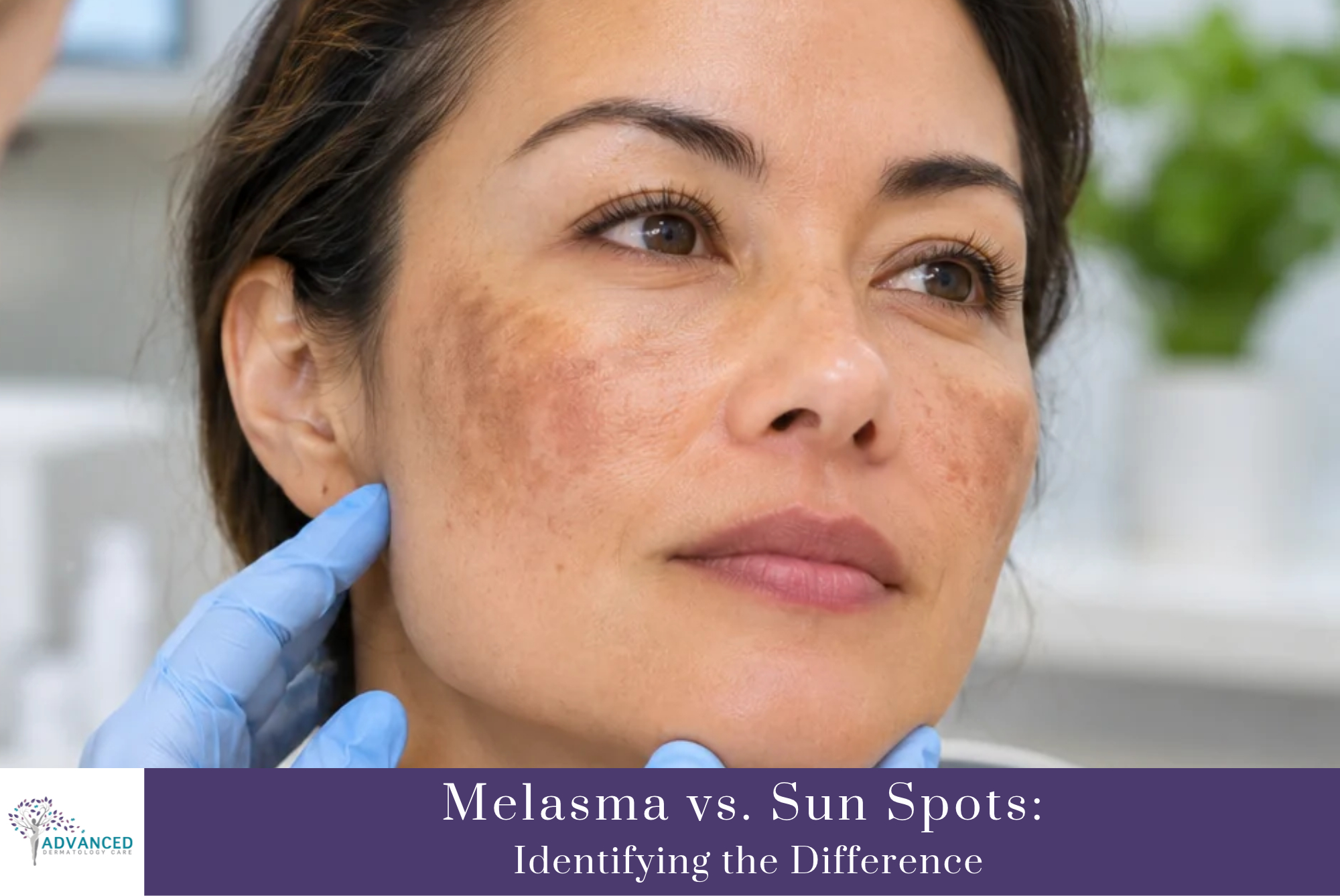
Brown patches, uneven pigmentation, and dark spots are common cosmetic and medical concerns, particularly among adults who experience significant sun exposure.
Two frequent causes are melasma and solar lentigines, commonly called sun spots or age spots.
Although these conditions can appear similar, they develop through different mechanisms and often require different treatment approaches.
At Advanced Dermatology Care, serving Los Alamitos and Agoura Hills, California, professional skin evaluations help identify the cause of pigmentation changes and determine appropriate treatment options.
What Is Melasma?
Melasma is an acquired pigmentation disorder characterized by irregular brown or gray-brown patches, most commonly on the face.
It frequently affects the cheeks, forehead, upper lip, and chin.
Melasma is particularly common among women and individuals with medium to darker skin tones, although it can affect anyone.
What Causes Melasma?
Melasma develops through complex interactions involving melanocyte activity, ultraviolet radiation, visible light, hormonal influences, and genetic susceptibility.
Pregnancy and certain hormonal medications can contribute to its development.
Melasma associated with pregnancy is sometimes called chloasma.
Heat and chronic sun exposure can aggravate pigmentation in susceptible individuals.
What Are Sun Spots?
Solar lentigines are benign pigmented lesions associated with cumulative ultraviolet radiation exposure.
They commonly appear as flat, well-defined brown spots on sun-exposed skin.
Frequent locations include the face, hands, shoulders, chest, and forearms.
Sun spots become more common with age because ultraviolet exposure accumulates over time.
Key Differences Between Melasma and Sun Spots
| Characteristic | Melasma | Sun Spots |
| Appearance | Irregular patches | More discrete, defined spots |
| Common location | Cheeks, forehead, upper lip | Face, hands, shoulders, arms |
| Primary influences | Light exposure, hormones, genetics | Cumulative ultraviolet exposure |
| Pattern | Often symmetrical | Frequently scattered |
| Recurrence | Common, especially with light exposure | Treated spots can improve; new ones can form |
| Treatment | Photoprotection and pigment-regulating therapy | Photoprotection and selected topical or procedural treatments |
Why Correct Diagnosis Matters
Not every brown spot is melasma or a harmless sun spot.
Pigmented lesions can also represent post-inflammatory hyperpigmentation, seborrheic keratoses, atypical moles, or skin cancer.
Lentigo maligna, a form of melanoma in situ, can resemble an irregular sun spot on chronically sun-exposed skin.
A new, changing, asymmetrical, or unusually dark lesion should be evaluated before cosmetic treatment.
How Dermatologists Diagnose Pigmentation Disorders
Diagnosis generally begins with a clinical examination.
A dermatologist considers the distribution, color, borders, duration, and history of the pigmentation.
Dermoscopy can help assess lesion structures and distinguish benign pigmentation from suspicious lesions.
A Wood’s lamp examination can sometimes provide additional information, although it does not reliably determine pigment depth in every patient.
A biopsy may be recommended when the diagnosis is uncertain or skin cancer is suspected.
Treatment Options for Melasma
Melasma management focuses on controlling excess pigmentation while preventing recurrence.
Broad-Spectrum Sun Protection
Daily photoprotection is fundamental.
Broad-spectrum sunscreen with SPF 30 or higher helps reduce ultraviolet exposure.
Tinted sunscreens containing iron oxides can provide additional protection against visible light, which contributes to melasma in some individuals.
Prescription Topical Treatments
Hydroquinone is a commonly prescribed pigment-reducing medication.
Other options include azelaic acid, retinoids, and carefully selected combination formulations.
Triple-combination therapy containing hydroquinone, tretinoin, and a topical corticosteroid is used for appropriate patients under medical supervision.
Chemical Peels and Other Procedures
Certain superficial chemical peels can improve pigmentation in selected patients.
Laser and light-based treatments require caution because inappropriate treatment can worsen melasma or cause post-inflammatory hyperpigmentation.
Oral Treatment Options
Oral tranexamic acid is sometimes used off-label for difficult melasma cases.
Because it has important contraindications and potential risks, including thromboembolic concerns, it requires careful medical assessment.
Treatment Options for Sun Spots
Solar lentigines can respond to topical pigment-regulating medications and selected dermatologic procedures.
Depending on the lesion and skin type, treatment can include cryotherapy, certain laser treatments, or carefully selected chemical peels.
Procedural treatments can cause temporary discoloration or pigmentation changes, especially in darker skin tones.
A dermatologist should confirm that the lesion is benign before cosmetic removal.
Why Pigmentation Can Return After Treatment
Melasma has a strong tendency to recur because its underlying susceptibility often persists.
Continued exposure to ultraviolet and visible light can reactivate pigmentation.
Sun spots can also develop in new locations as cumulative ultraviolet exposure continues.
Long-term maintenance and consistent sun protection are therefore important.
Preventing Uneven Pigmentation in Southern California
Outdoor activities, beach visits, driving, and recreational sun exposure can contribute to pigment changes throughout the year.
Daily sunscreen, hats, shade, and avoiding intentional tanning help reduce ultraviolet damage.
The American Academy of Dermatology provides additional patient education about melasma.
When Should You See a Dermatologist for Dark Spots?
Professional evaluation is recommended when pigmentation changes rapidly, develops irregular borders, or appears significantly different from surrounding spots.
Patients with persistent melasma or unwanted sun spots can also benefit from an individualized treatment discussion.
Advanced Dermatology Care serves patients in Los Alamitos, Agoura Hills, and surrounding Southern California communities.
Frequently Asked Questions About Melasma and Sun Spots
Is melasma the same as sun damage?
Melasma is influenced by light exposure but also involves hormonal, genetic, and other biological factors. Sun spots are more directly associated with cumulative ultraviolet exposure.
Can melasma go away permanently?
Melasma can improve substantially, but recurrence is common. Maintenance treatment and consistent photoprotection are important.
Are sun spots dangerous?
Typical solar lentigines are benign. However, suspicious pigmented lesions can resemble sun spots and should be evaluated.
Can pregnancy cause melasma?
Yes. Hormonal changes during pregnancy can contribute to melasma development.
Does sunscreen help fade melasma?
Sunscreen helps prevent worsening and supports the effectiveness of other treatments, but existing pigmentation often requires additional therapy.
Are laser treatments safe for melasma?
Certain laser treatments can be used selectively, but melasma can worsen after inappropriate laser or light-based procedures.
Can melasma affect men?
Yes. Melasma occurs in men, although it is more commonly diagnosed in women.
How long does pigmentation treatment take?
Improvement commonly requires several weeks to months, depending on the condition, treatment, and adherence to photoprotection.
Contact Information
Advanced Dermatology Care
Los Alamitos Office
3851 Katella Avenue, Suite 105
Los Alamitos, CA 90720
Phone: (562) 799-3330
Agoura Hills Office
30300 Agoura Road, Suite 200
Agoura Hills, CA 91301
Phone: (818) 706-3744
Website: mddermcare.com
Book Online: Schedule Your Appointment
Schedule a dermatologic evaluation to identify the cause of unwanted pigmentation and discuss appropriate treatment.