
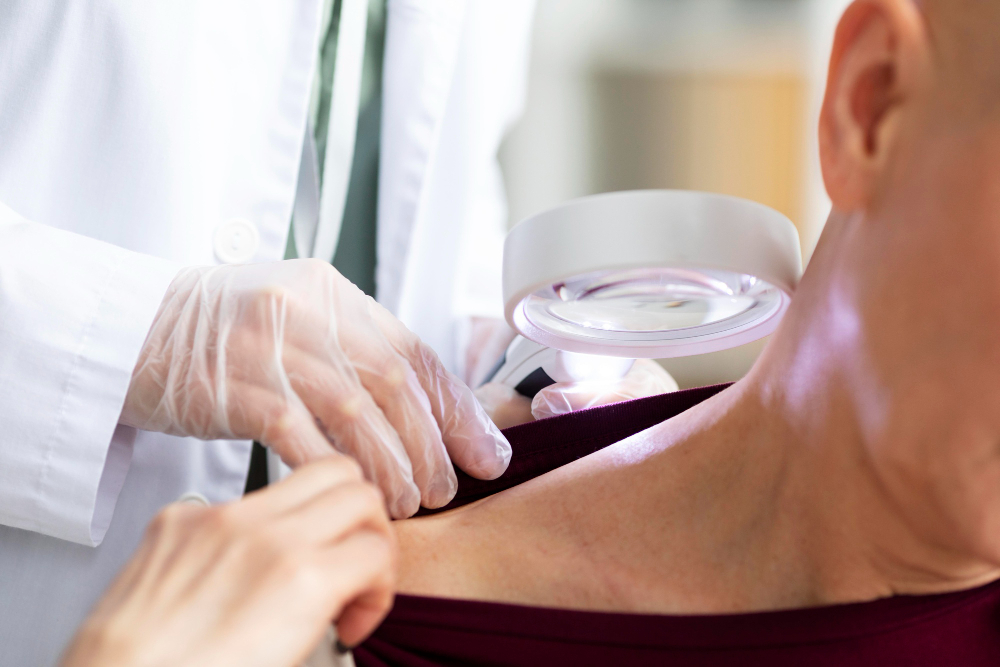
May marks the beginning of Skin Cancer Awareness Month—a crucial time dedicated to raising awareness about the most common type of cancer in the United States. Whether you’re a sun worshipper or someone who spends most of their time indoors, this month serves as an important reminder to protect your skin and educate yourself about the risks and prevention methods for skin cancer.
Understanding Skin Cancer
Skin cancer occurs when the skin cells grow uncontrollably due to DNA damage, often from ultraviolet (UV) radiation. There are three major types of skin cancer:
- Basal Cell Carcinoma (BCC): The most common type, often appearing as a waxy bump or flat lesion.
- Squamous Cell Carcinoma (SCC): This type may appear as a firm red nodule or a flat lesion with a scaly, crusted surface.
- Melanoma: The most dangerous form, which can develop in existing moles or suddenly appear as a new dark spot.
The Importance of Early Detection
Early detection is key to effectively treating skin cancer. Here’s what you need to look out for:
- Asymmetry: One half of the mole doesn’t match the other half.
- Border: The edges are irregular, ragged, or blurred.
- Color: The color is not the same all over and may include shades of brown or black, sometimes with patches of pink, red, white, or blue.
- Diameter: Spots larger than 6mm (about the size of a pencil eraser) can be concerning.
- Evolving: Any change in size, shape, color, or elevation of a spot on your skin, or any new symptom in it, such as bleeding, itching, or crusting.
If you notice any of these signs, it’s essential to visit a dermatologist for a professional evaluation.
Prevention is Better Than Cure
While early detection is crucial, prevention remains the best strategy. Here are some practical tips to protect your skin:
1. Use Sunscreen Daily
Apply a broad-spectrum sunscreen with at least SPF 30 every day, even on cloudy days. Reapply every two hours, or more often if swimming or sweating.
2. Seek Shade
The sun’s rays are strongest between 10 AM and 4 PM. Try to stay in the shade during these hours to minimize UV exposure.
3. Wear Protective Clothing
Long-sleeved shirts, wide-brimmed hats, and sunglasses can significantly reduce your skin’s exposure to harmful UV rays.
4. Avoid Tanning Beds
Tanning beds emit harmful UV radiation that can increase your risk of skin cancer. Opt for safer alternatives like self-tanning products.
5. Perform Regular Skin Checks
Examine your skin head-to-toe every month, looking for any new or changing spots. Annual skin exams by a dermatologist are also recommended.
Join the Movement
Skin Cancer Awareness Month is an excellent opportunity to spread the word about skin cancer prevention and early detection. Share this information with friends and family, host or participate in community events, and consider donating to organizations dedicated to skin cancer research and awareness.
Together, we can make a difference. Stay vigilant, protect your skin, and encourage others to do the same.
Learn More
For more information on skin cancer prevention and early detection, and to access valuable resources, visit the Skin Cancer Foundation or the American Academy of Dermatology.
Disclaimer: Please note that the information presented on our blog serves solely for educational and sharing purposes and is not intended to be interpreted as professional healthcare guidance. We strongly advocate for consulting with a licensed medical practitioner for any health-related concerns and suggest relying on their expertise rather than the content available here. In urgent health situations, dial 911 or head straight to the closest emergency facility without delay.
We might offer links to third-party websites for additional reference; however, visiting these sites is entirely your choice and comes with certain risks, adhering to the policies of those sites. Advanced Dermatology Care and its contributors do not vouch for the authenticity or the exactness of the data found on these external platforms.
Interacting with our blog content does not form a patient-doctor connection. If you are seeking personalized medical advice or treatment, getting in touch with a certified healthcare professional is advised. To arrange a consultation with a medical specialist, you are welcome to call our office at (562) 799-3330.